
As I surveyed the landscape before me, I was overcome with its stark beauty and solitude. From my seat atop a camel, the desert appeared in various forms, from immense dunes and high mesas to dry washes bordered by tamarisk.
And the vivid orange/red hues cast on the sand, along with the deepening shadows as the sun began to set, were mesmerizing.
The Sahara Desert’s Beauty Is Spellbinding
I was in the Sahara, the largest desert in the world, with a total area of some 3,320,000 square miles.
This behemoth fills nearly all of North Africa and includes at least part of ten countries, including Morocco, my current location.
The vastness of this dramatic scene and the complete stillness of the environment worked its magic on me. And I had to pinch myself to ensure this experience was real and not just a mirage.
This was something I found myself doing quite often during my time in this bewitching country.
Why Choose A Private Tour With Wilderness Travel
My husband and I were on a private tour of Morocco with Wilderness Travel, a highly reputable and award-winning company that specializes in crafting unique and authentic travel experiences for discerning travelers.
Since their founding in 1978, they’ve earned much recognition and many accolades for their innovative trips (small group and private) to some of the most adventurous corners of the globe.
The company is also well known for providing top-notch personal service to its clients from start to finish, with an attention to detail and organization.
And their leaders are some of the best in the industry.
They come from a variety of backgrounds and have an extraordinary knowledge of their destinations, along with a desire to share this information.
After reading the company’s glowing reviews, it was an easy decision to select Wilderness Travel for our “Morocco Private Journey: Imperial Cities, the Great Sahara and Marrakesh.”
And upon meeting our guide Hassan and driver, also named Hassan, I knew we were in good hands. Both men were patient, courteous, and kind, and had a passion for their country’s culture, history, and traditions.
They went above and beyond their duties, and over the course of the nine-day tour, we developed a warm connection with them.
Read More: Morocco Travel Guide: Frequently Asked Questions About Travel in Morocco
Ancient and Modernity Blend in Rabat
There were many highlights of this private tour. First off was Rabat, the country’s capital and a UNESCO World Heritage City.
This city is known for its architectural gems, plentiful green spaces and tree-lined streets, and world-class museums and gardens. Historical sites blend seamlessly with the impressive modern urban planning in this pristine town.
Mausoleum Of Mohammed V

To explore Rabat, we had our own city guide who introduced us to the Mausoleum of Mohammed V.
This revered landmark houses the tombs of King Mohammed V (the current king’s grandfather) and his two sons, and it’s a showcase of Moroccan craftsmanship.
The monument, with its white marble, green tile roofing, stunning mosaics, carved plaster, and cedar wood ceiling, is jaw-dropping.
This architectural marvel is not only a burial place, but also serves to honor Mohammed V, who led Morocco to independence from French colonial rule in 1956.
It symbolizes the country’s struggle for independence and its cultural identity.
Hassan Tower Is Eye-Catching
Located in Al-Mansour Square, the mausoleum stands near other significant monuments like Hassan Tower and Oudaia Kasbah.
The 12th-century Hassan Tower, an imposing, red sandstone minaret, is another symbol of Rabat and remains the sole vestige of what was planned to be the largest mosque in the world.
However, it was never finished, as Sultan Al Mansour, who initiated the construction, died, and his successors lacked the money or impetus to finish it.
Oudaia Kasbah Highlights
The Oudaia Kasbah, a UNESCO World Heritage Site, dates back one thousand years.
This ancient fortress is notable for its blend of Moroccan, Andalusian, and Islamic artistry, vivid blue and white alleyways, and panoramic vistas of the Atlantic Ocean and Bou Regreg River.
An imposing gate makes a grand entrance statement, and the Andalusian Gardens within are Eden-esque.
This is also the home of the National Museum of Jewelry, which has an admirable collection of historical Moroccan costumes and Berber jewelry.
Exploring Ancient Volubilis
The next day, we went to Volubilis, a vast Roman ruin surrounded by fertile farmlands. It’s Morocco’s most important archaeological monument and a UNESCO World Heritage site.
To learn more about this complex, we had a dedicated guide take us around for a captivating glimpse into its historical richness.
Once again, I had to pinch myself as I gazed at the well-preserved structures, realizing they dated back to the 2nd and 3rd centuries. If these stones could talk, the tales they would tell…
Volubilis was Rome’s provincial capital in Morocco and served as an important outpost of the Roman Empire. At its peak, it was inhabited by 20,000 people.
And it was graced with many fine buildings, being the realm of wealthy denizens and retired military. Our guide likened it to a retirement community and called it the “Florida of Morocco.”
Volubilis Site Highlights
There’s plenty to see here, and only fifty percent of the site has been excavated to date.
Notable structures include the Forum, House of Orpheus, Triumphal Arch of Volubilis, and the remains of the Baths of Gallienus.
The Forum was the heart of the city’s public and social life, and is where the Temple of Jupiter, Juno, and Minerva, as well as the basilica, are located.
The House of Orpheus is the largest and most beautiful house in Volubilis and contains a mosaic with the figure of Orpheus playing the lute to enchant the animals.
It has a private hammam with a hot room equipped with steam tubes, a tepid room, a cold room, and a solarium.
Next door is the House of the Acrobat, also worth checking out, as there’s a mosaic of an athlete receiving a trophy.
The remains of the Baths of Gallienus are remarkable as they reveal the sophistication of the underground heating systems – a feat of Roman engineering.
And then there’s the Triumphal Arch, which was built in marble as a tribute to an emperor and his mother. It was once crowned by a bronze chariot with four horses, then rebuilt in the 1930s.
From here, you have a panoramic view of the entire site.
Don’t Miss The Mosaics!
The amount of artistic material produced, such as the mosaics, marble and bronze statues, and inscriptions, is extraordinary.
The mosaics, we were told, are the most valuable feature of this complex, and almost all the houses in the site contain mosaics.
Many of these domiciles are named after the images the mosaics depict, such as the House of the Tasks of Hercules, the House of Dionysus and the Four Seasons, the House of the Wild Beasts, and the House of the Bathing Nymphs.
The finest examples, however, are in the House of Venus and portray romantic and erotic themes.
Discover Fascinating Fes
After the splendor of Volubilis came Fes, one of Morocco’s Imperial Cities. The others are Marrakesh, Meknes, and Rabat. Of these, Fes is the oldest, with a history dating back to 769.
This UNESCO World Heritage Site is very popular with tourists, as it’s dotted with minarets and domes, not to mention a 9th-century medina, one of the most perfectly preserved medieval towns in the world.
Ancient Medina Of Fes Is A Feast For The Senses
Our city guide in Fes wowed us with his extensive knowledge of the place, and having grown up in the medina, he knew his way around its 9,760 alleyways!
This enormous rabbit warren is over 500 acres and has 40,000 permanent residents.
It’s the largest pedestrian-only area in Morocco, and within it are souks, or market stalls, selling a wide variety of wares, open-air cafes, courtyards, hammams, squares and gardens, schools, houses, museums, and a mosque.
The place bustles with activity, as both people and donkeys laden with goods tread the narrow passages. The medina is a photographer’s dream with photo ops in every nook and cranny.
My head was on a swivel, as there were so many visual, not to mention other sensory delights. I loved the mounds of different kinds of figs and spices; the latter, which were piled up in triangles or in bags perfectly organized.
They made for great photo subjects, as did the kaleidoscope of patterns and textures of the textiles hanging from poles and rafters.
Within the medina, we saw the Katrouine Mosque, which was established in 859 and considered the world’s oldest university, and Attarine Medersa, a school built in 1325 with magnificent mosaics.
The Museum of Moroccan Art was also a treat with its examples of woodcarving, tilework, and pottery.
Living Arts Of Fes
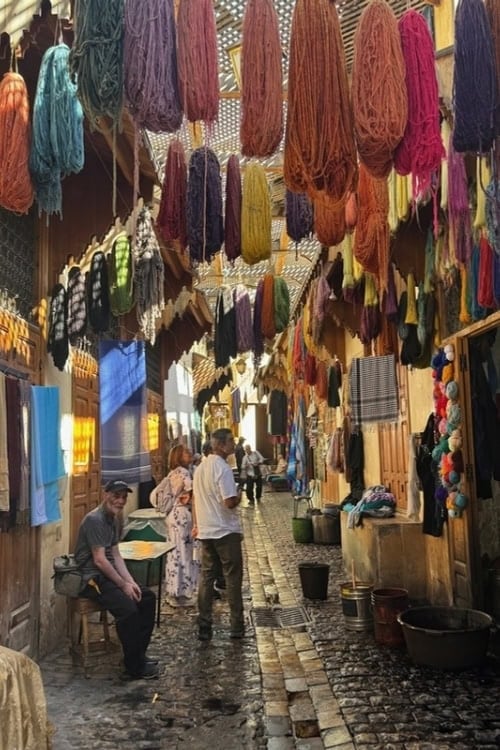
Of special interest to me were the traditional Fes artisan and trade workshops we visited, including a ceramics company, embroidery cooperative, weaving studio, copper, brass, and silversmith shop, and tannery.
It was thrilling to watch skilled artisans turn raw materials into things of beauty. The Chouara Tannery, which dates back to the 11th century, was a particularly impressive operation.
We had a view of the workers, many from generations of the same families, practicing ancient methods to process and (naturally) dye leather.
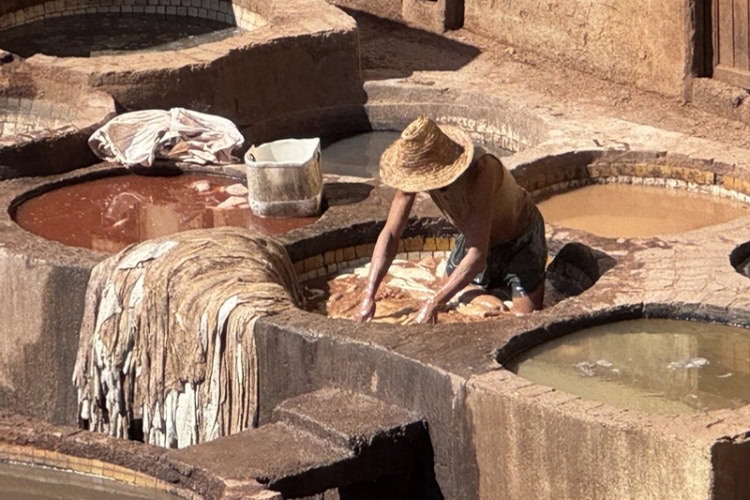
It’s an extensive undertaking that takes a total of 45 days to transform the animal skins into leather.
We were warned ahead that the tannery had strong odors, which it did! Thankfully, these were mitigated by fresh mint sprigs for us to smell during our tour.
Falling Under The Desert’s Spell

The Sahara was our next stop, and as previously mentioned, I quickly fell under its spell. We stayed at a private desert camp, where we glamped amid the majestic dunes.
Our home was a luxury tent, complete with all the amenities, including comfy beds and a private bathroom with a shower.
The canvas interior was hung with bright fabrics and carpeted with colorful Moroccan rugs. I felt like I was in a sheik’s retreat.
You’ll Eat Like Royalty At This Desert Camp!
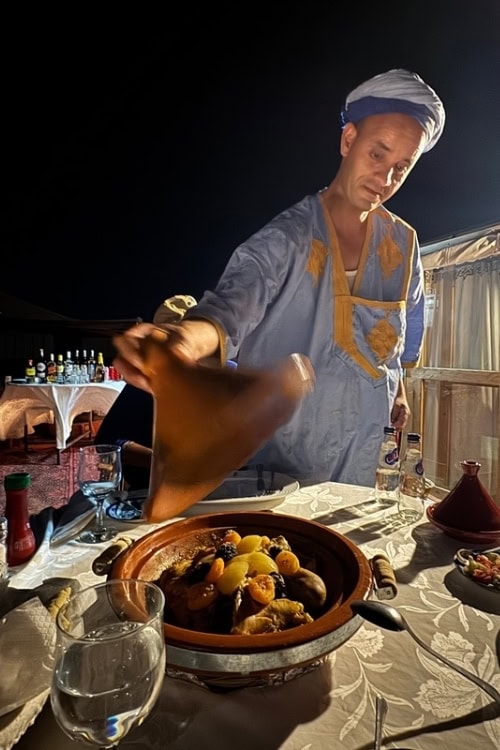
Meals were either served in a large dining tent or outside under the stars.
The food was delicious and plentiful, with an array of traditional dishes, from couscous and tagines (a tagine is a conical, earthenware cooking pot used to slowly simmer meats), to different kinds of brochettes and chicken pastillas.
Chicken pastillas are shredded chicken with almonds, ginger, and cinnamon, wrapped in phyllo dough. There was always a selection of Moroccan salads, baked breads, fresh fruit, and desserts like flan and sticky sweets.
And of course, tea, or “Moroccan whisky,” as it’s humorously called!
Tea Rituals And Hospitality

Moroccan tea is central to Moroccan life and is the country’s national drink. Preparing and serving it is an art that symbolizes hospitality, friendship, and tradition.
When you visit someone’s home, or check into a hotel or guesthouse, for example, it’s customary for the host or proprietor to serve you tea.
Typically made with gunpowder green tea, mint leaves, and sugar, it’s then poured from up high so as to create a layer of foam or frothy top on the tea.
I enjoyed this ritual immensely, as I found the tea to be soothing and calming. Though it could also be invigorating, due to the caffeine. Healthwise, the mint gave it a nice immune boost, too.
Evening Entertainment Under the Desert Stars
In the evening, we were serenaded by a group of Gnawa musicians, who played several traditional instruments.
There were types of lutes, bowed and plucked, large drums called tbel, and a kind of castanet known as karkabas.
We were told the repertoire of songs sung was derived from ancient African Islamic spiritual heritage. At one point, some of the members got up and danced, then invited us to join them.
I did my best to mimic their movements, but then quickly opted to improv my own steps. Our guide said it didn’t matter how you danced, just that you did so with joy.
Riding A Dromedary Camel

As for the aforementioned camel ride, I learned that the camels in Morocco are dromedaries with one hump, as opposed to two.
To get on this creature, you wait until it’s lying down before climbing aboard. Then, as the camel rises up, you lean back and repeat this motion whenever you’re going downhill, and then again at the completion of the ride.

Conversely, on the uphill, you lean forward. I can’t say it was a comfortable ride, as the camel’s gait is irregular, but I got used to the sensation once I physically relaxed and allowed myself to sway with the animal.
Besides, I was so enamored with the stunning landscape that comfort was not a priority.
I Spy A Barbary Ape!

After our stay in the Sahara, we drove through the Middle Atlas Mountains, where we were fortunate to spot the famed Barbary apes, or macaque monkeys, as they are officially named.
These tailless, ground-dwelling creatures are native to Morocco and inhabit the cedar forests. They live in the wild in colonies, and surprisingly, the males are the ones who are responsible for taking primary care of the babies.
The macaques are an endangered species here and are listed as protected by the national legislation of Morocco.
Some of the monkeys are accustomed to seeing travelers on this route and will approach you, looking for food.
They are frugivorous, preferring fruit as the main staple of their diet, and if you have apples or bananas, they tend to get up close and personal.
I chose not to feed them, keeping in mind they are wild animals – with teeth!
Canyon Country Spectacles

Morocco’s canyon country was another favorite highlight of the trip. Both Todra Gorges and Dades Gorges offer different types of landscapes, each uniquely picturesque.
As you enter Todra, the canyon walls narrow and squeeze together between looming limestone cliffs.
We got out of the car to walk through this corridor, and I felt like I was in Mother Nature’s sacred cathedral.
Alongside us was the Todra River, which was responsible for carving this amazing formation over millions of years, though now it’s a mere trickle.
The Dades Gorges in the High Atlas Mountains have a more open feel. Its red cliffs, which are home to Berber villages, are reminiscent of those of the American Southwest.
They reminded me of the landscape near my home in Santa Fe, New Mexico, and I could imagine a Hollywood western being filmed there.
Also within the Dades Gorges area are unique rock formations that our guide called “monkey fingers.” They’re tall, stone columns that reach upward toward the sky and look like ginormous hands.
Driving through this gorge was in and of itself a memorable experience, and kudos to our driver Hassan for safely navigating the winding, serpentine road.
I was glad he was at the wheel, as I was too focused on the breathtaking views at every hairpin turn.
Cinema Sites And Caravans
Interestingly, Morocco has earned a reputation for being able to offer a wide variety of movie set locations, as it boasts enormous landscape versatility.
Many productions have been filmed in the country, and there’s actually a Moroccan Hollywood, or “Mollywood!”
The town of Ouarzazate has become the center of cinema in the region, with Atlas Film Studio one of a series of studios operating in this area.
But whereas these studios recreate ancient villages as sets, the real thing can be found at Aït Benhaddou.
This historic fortified village or ksar is situated on the Road of a Thousand Kasbahs, between the Sahara and Marrakech.
This historical route traces that which was taken by caravans traveling from Morocco to Sudan and Mali.
Authentic Aït Benhaddou

At Aït Benhaddou you’ll find a complex of buildings, which has been recognized by UNESCO, and is an excellent example of earthen clay architecture.
It stands on the slopes of a hill beside a river, giving it an ideal defensive position.
To reach the top of the village, you need to walk up a series of switchback stairs and ramps. Along the way, there are small shops and cafes. The reward is a breathtaking view of the surrounding scenery.
Hollywood has been using this site as a film location since the 1960s, and it has provided authentic backdrops for numerous movies.
These include The Man Who Would Be King, Marco Polo, The Jewel of the Nile, The Mummy, Gladiator, Babel, and parts of the TV series Game of Thrones.
Touring The Red City
Our last destination was Marrakesh. Known as the red city for its rose-hued buildings, this town has Berber rather than Arab origins.
Two-thirds of Moroccans are actually Berbers, or Imazighen as they call themselves. They are of mixed origin, including European and Saharan people.
Years ago, they took refuge in the mountains, which helped them survive invasions by other civilizations.
Berbers are Muslims but incorporate some traditional beliefs of their former religious practices.
Marrakesh’s Medina Dazzles
The beating heart of Marrakesh is its 11th-century medina and the Djemaa el Fna, the main square, where a host of colorful performers gather, such as snake charmers, musicians, dancers, acrobats, monkeys, and other characters.
I didn’t see an Aladdin, but I certainly felt like I was in a scene from the movie.
You might find, as I did, that some of these people can be somewhat aggressive, as they want you to take their pictures – for a fee, of course.
As in Fes, the medina is home to a labyrinth of souks selling everything you think you might need and things you didn’t know you wanted, from spices and carpets to leather goods and jewelry.
The sheer amount of merchandise is staggering and overwhelming, yet visually dazzling. This is where craftsmanship and commerce unite, and traditions are still alive.
Read More: Marrakech by Night: A Guide to the City’s Most Vibrant Markets, Gardens and Rooftop Bars
Majorelle Garden Is A Lush Oasis

Our city tour guide first took us to the charming Majorelle Garden, with its assortment of cacti, water features, and tropical desert plants.
Originally designed by French painter Jacques Majorelle in 1923 and built over forty years, this 2.5-acre botanical oasis includes specimens from five continents.
It’s a feast of color, with dazzling cobalt blue, orange, yellow, and green hues. Surrounding buildings blend Art Deco and Moorish styles, which add to this vivid scene.
After Majorelle passed away in 1962, the garden remained open to the public but deteriorated physically.
Flash forward to 1980, when fashion designer Yves Saint Laurent and Pierre Bergé bought the garden to save it from being bulldozed by hotel developers.
The pair restored the site to its original splendor, ensuring its continued operation as a public garden.
Two museums are also housed within the garden: the Museum of Islamic Art, which showcases the personal art collections of Saint Laurent and Bergé, along with an exhibit of the paintings of Majorelle, and the Berber Museum.
The latter has a wonderful collection of Berber clothing, jewelry, and artifacts that display the vibrancy of the Berber culture. More than 600 objects were compiled by Saint Laurent and Bergé.
Check Out The Secret Garden
Le Jardin Secret, or the Secret Garden, is another popular botanical sanctuary in Marrakesh. It dates back to the late 1500s and was likely part of a palace.
There are actually two gardens here: the Exotic Garden and the Islamic Garden. The first comprises plants indigenous to a number of countries, such as Australia, Brazil, Mexico, South Africa, the U.S., and others.
There are agave and aloes, herbs and grasses, and a host of trees and shrubs chosen specifically for their resistance to drought.
The Islamic Garden, on the other hand, showcases plants typically found throughout Morocco.
Our guide pointed out one of the most important features of the garden – its restored ancient water system, known as a khettara.
This underground irrigation network, a marvel of engineering, transported water from the Atlas Mountains straight into the city’s palaces and gardens.
Historical Ben Youssef Medrassa Is A Must-See Site

The Ben Youssef Medrassa was another attraction on our agenda. Built in the 14th century, it was once the largest school in North Africa.
It’s an architectural treasure within the old medina and has great historical significance.
Constructed by Sultan Abdullah Al-Ghaleb Assaadi between 1564 and 1565, this building was a place where students and teachers could meet and share knowledge and ideas.
It attracted scholars and thinkers from around the Muslim world.
Notable features include a symmetrical main courtyard with a reflective pool, detailed tile work, and carved cedar wood ceilings.
By contrast, the student rooms, which are arranged around the courtyard on the upper floor, are very modest and functional.
Our guide mentioned that their compact spaces were made to evoke the humility of the apprentice-scholars.
As I peeked inside a few rooms, I shuddered, as they were very tiny and claustrophobic, and most had no windows.
Saadian Tombs Splendor
Additionally, we visited the Saadian Tombs, a royal necropolis from the 16th to 18th centuries that was sealed off and intentionally hidden for over 200 years. It was only rediscovered in 1917.
Created by Sultan Ahmed Al Mansour Ed Dahbi, known as the golden king, this lavish tomb complex boasts Italian Carrara marble, elaborate tilework, and decorative plasterwork with gold.
And the Chamber of the 12 Pillars, the most luxurious section, is naturally the final resting place of the sultan and his sons. There are two other tomb rooms nearby.
One is where alpha princes and favored members of the royal court are buried, and the other is the mausoleum of Al Mansour’s mother, Lalla Massouda.
The rest of the tombs here belong to other important women of the court.
Outside, in the garden plot, are the garden tombs, where other royal household members and chancellors are buried.
Though Al Mansour died in splendor in 1603, several decades later, Alaouite Sultan Moulay Ismail decided to close up the Saadian Tombs to keep his predecessors out of sight and mind.
Comforts Of Moroccan Stays

As for accommodations during this trip, Wilderness Travel booked us in an array of wonderful properties that included historic riads, a guesthouse, and a hotel.
Rooms in each were spacious and comfortable, and furnished in colorful traditional decor.
Some had private terraces and lush gardens, or exquisite courtyards with swimming pools. A few had spas and hammams, and even fitness facilities.
Food was plentiful and tasty, the service was impeccable, and the hospitality was warm and welcoming.
Memories of Morocco will remain with me, hopefully forever. The faces of the people, the culture, food, history, and captivating landscape are vividly imprinted in my mind and nestled within my heart.
Morocco Private Guided Tour | Fes, Marrakesh & Sahara Desert
Wilderness Travel | Award-Winning Adventure Tours
Travel insurance is essential for any trip, offering peace of mind and protection. Explore options with SafetyWing or SquareMouth to find the coverage you need.
Need a hand planning your trip? Here are the sites and services we rely on most, from booking tools to travel products we love.
Inspire your next adventure with our articles below:
Want to discover more hidden gems and helpful travel tips? Join our free newsletter for the latest travel secrets and travel articles.
We are reader-supported and may earn a commission on purchases made through links in this article.
unique destinations and experiences to share with her readers and listeners. She’s an avid
explorer who welcomes new opportunities to increase awareness and enthusiasm for places,
culture, food, history, nature, outdoor adventure, wellness and more. Her travels have taken her
to nearly 100 countries spanning all seven continents, and her stories appear in numerous print
and digital publications.