When passengers board a Japan Airlines Airbus A350-1000 from  Tokyo Haneda Airport to
  New York JFK Airport or settle into a Qatar Airways A350-1000 from
  Doha Hamad International Airport to
  Los Angeles International Airport, they are stepping onto some of the longest nonstop flights in the world. On other days, a Boeing 787-9 might be covering similarly demanding missions, such as
  San Francisco International Airport to
  Singapore Changi Airport or Perth International Airport to
  London Heathrow Airport. Both aircraft sit at the top end of the long-haul market, but there is a clear gap between them in one key area: range.
This article examines how much more range the Airbus A350-1000 offers compared to the Boeing 787-9, and why that difference matters. We will compare manufacturer figures, look at how airlines actually use each type on real-world routes, and explore the trade-offs between range, payload, and cabin configuration. By the end, you will have a clearer picture of where the A350-1000’s extra range makes a difference, and where the 787-9 remains the more efficient choice.
A350-1000 vs 787-9: The Basics

On paper, both the Airbus A350-1000 and the Boeing 787-9 are long-range, twin-engine widebodies designed to carry roughly three hundred passengers across oceans. The A350-1000, however, sits a size class above the 787-9 and was designed from day one to push deeper into ultra-long-haul territory. Airbus markets the A350-1000 as a “long range leader,” and the headline numbers support that. In typical three-class layouts, Airbus advertises around 375 to 400 seats, with a certified maximum of 480. The published range is about 9,000 nautical miles, backed by a maximum takeoff weight of roughly 322 tonnes and a fuel capacity of more than 168,000 liters.
The 787-9 aims at a different sweet spot. It keeps the same wingspan as the smaller 787-8 but stretches the fuselage by about six meters, giving a typical two-class capacity of roughly 280 to 300 passengers. Boeing lists the 787-9’s range at about 7,565 nautical miles, with a maximum takeoff weight around the mid-250-tonne mark – roughly 60 to 70 tonnes lower than the A350-1000, depending on the weight variant. In short, the 787-9 is lighter, smaller, and optimized for efficiency on most intercontinental routes rather than the very longest missions.
Both aircraft cruise at near Mach 0.85 and rely on composite structures and new-generation engines to reduce fuel burn compared to older types. The trent XWB-97 on the A350-1000 and the General Electric GEnx and Rolls Royce Trent 1000 families on the 787-9 are all highly efficient high-bypass turbofans, but they power airframes tuned to slightly different missions. Even before looking at specific routes, there is already a numerical gap of roughly 1,400 nautical miles between the two designs.
This table shows the core story: the A350-1000 typically carries more passengers and offers roughly 1,400 additional nautical miles of advertised range compared to the 787-9, at the cost of a heavier airframe and higher maximum weights.
|
Metric |
Airbus A350-1000 |
Boeing B787-9 |
Notes |
|---|---|---|---|
|
Typical passenger capacity |
About 375~400 seats(3-class) |
About 280~300 seats(2-class) |
Typical layouts |
|
Manufacturer range(nm) |
About 9,000nm |
About 7,565nm |
Catalog figures |
|
MTOW(tonnes) |
About 308~322t |
About 250t |
A350-1000 is 60~70t heavier |
|
Cruise Mach Number |
M0.85 |
M0.85 |
Similar cruise speeds |
How Airlines Use The A350-1000’s Extra Range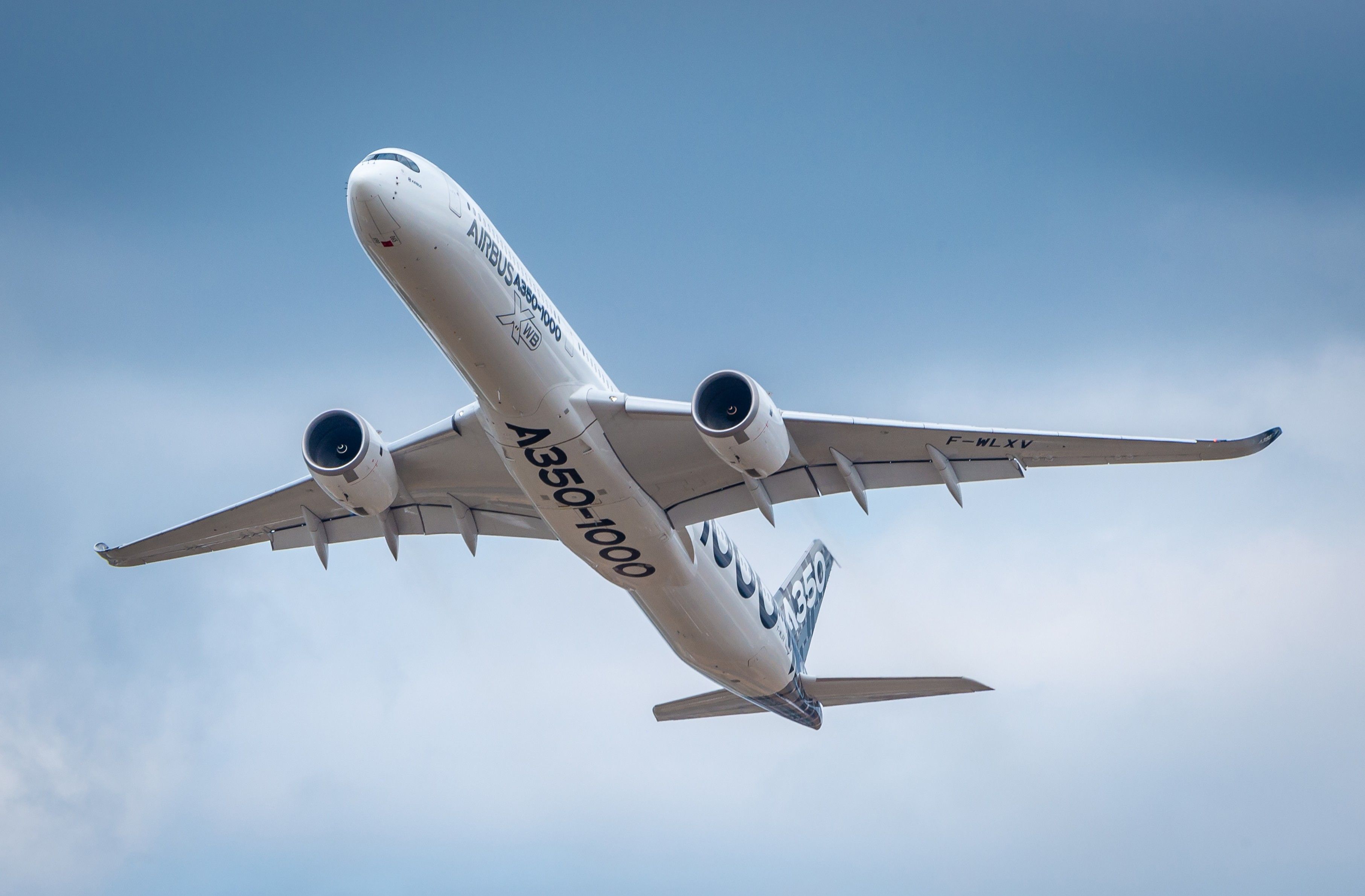
On manufacturer data alone, the A350-1000’s advantage looks simple: about 9,000 nautical miles versus about 7,565 for the 787-9. In practical terms, that is roughly three more hours of flying at cruise speeds, depending on routing and winds. In reality, airlines rarely exploit the full brochure number, but the extra headroom still matters.
Range figures assume specific payloads, cabin layouts, and reserves. An A350-1000 with a very premium-heavy cabin might not reach the full theoretical 9,000 nautical miles with maximum payload, while a lightly configured 787-9 can occasionally stretch beyond its catalog figure. Even so, the A350-1000’s additional margin lets airlines plan missions that would push a 787-9 close to its limits, particularly when strong headwinds, diversion options, or higher cargo loads are factored in.
Qatar Airways, British Airways, and Japan Airlines use the A350-1000 on some of their most demanding flights. Qatar’s Doha–Los Angeles and Doha–Dallas/Fort Worth services can approach fifteen hours, often into winter headwinds.
|
Airline |
Route |
Aircraft Type |
Approx. Block Time |
Notes |
|
HND – JFK |
A350-1000 |
12~13 hours |
Premium-heavy flagship route |
|
|
DOH – LAX |
A350-1000 |
15 hours |
Strong seasonal headwinds, high payload |
|
|
DOH – DFW |
A350-1000 |
14~15 hours |
Long sector with cargo demand |
|
|
LHR – CPT |
A350-1000 |
11~12 hours |
Long southbound route, flagship deployment |
|
|
PER – LHR |
B787-9 |
17 hours |
Famous nonstop, near upper range of 787-9 |
|
|
|
SFO – SIN |
B787-9 |
17 hours |
Very long transpacific, high utilization |
|
AKL – ORD |
B787-9 |
14~15 hours |
Very long transpacific, high utilization |
 Qatar Airways
 British Airways
 United Airlines
Japan Airlines deploys the type on premium-heavy routes such as Tokyo Haneda–New York JFK and London Heathrow, where reserves and diversion flexibility are crucial. British Airways treats the A350-1000 as a flagship on the long sectors from London to destinations like Cape Town, Nairobi, and Toronto, combining significant distance with high payload expectations.
In these cases, the A350-1000’s extra range and payload capability allow airlines to keep generous cabins and strong cargo loads without trimming the product or adding technical fuel stops. The margin is not just about flying farther; it is about flying demanding routes with fewer compromises.

How The 787-9 Uses Its Range

The Boeing 787-9 tells a different story. Rather than being stretched to the absolute limit, its range underpins a broad network of long-haul and ultra-long-haul routes with a focus on efficiency and right-sizing. Airlines such as United, British Airways, Qantas, and Air New Zealand have built large parts of their long-haul strategy around the type.
Qantas used the 787-9 for nonstop flights between Perth and London, a route that pushes the aircraft toward the top of its range while relying on a carefully managed payload and a premium-focused cabin. United’s San Francisco–Singapore and Los Angeles–Sydney services show that the 787-9 can handle very long sectors with strong economics when operated within its performance envelope. Air New Zealand’s flights from Auckland to Chicago and other long North American destinations highlight how the 787-9 can open and sustain distant city pairs that might be too thin for a larger aircraft like the A350-1000.
For many airlines, the 787-9’s strength is that it has enough range for almost all long-haul markets they want to serve, while remaining small and efficient enough to avoid over-capacity. It is often scheduled on long flights, but not at the absolute limits of what is technically possible. That leaves some of the A350-1000’s theoretical range unused in day-to-day operations but allows the 787-9 to deliver very competitive economics on a wide variety of missions.

Analysis: 5 Airlines From Around The World With High-Density Boeing 787-9 Configurations
Several different operators of the type favor economy-heavy layouts.
What Extra Range Really Changes

When airlines compare range, they think in terms of payload as much as distance. The A350-1000’s higher maximum takeoff weight and larger wing give it more room to balance passengers, cargo, and fuel on very long sectors. That can translate into more freight, more generous seating, or larger fuel reserves without hitting performance limits as quickly. Many operators use the A350-1000 as a showcase for flagship cabins, with spacious business-class seats and substantial galley and crew-rest space, yet still have enough performance to operate long missions reliably.
The 787-9, while also capable of carrying high-quality cabins, is often used more flexibly. Airlines deploy it on everything from ultra-long-haul services to medium-haul routes where range is not critical, but fuel burn and trip cost still matter. On the very longest 787-9 flights, there can be tighter limits on cargo or extra weight, particularly during seasons with strong headwinds or high temperatures.
In practice, this means the A350-1000’s extra range is frequently “spent” on payload and comfort rather than simply stretching route length. Airlines use the margin to keep cabins spacious and bellies full of cargo on demanding sectors. The 787-9 focuses on handling most of the world’s long-haul work with a leaner structure and lower operating costs.
When Extra Range Really Counts

From a passenger perspective, more range might sound like an automatic win. Airlines, however, pay for every extra nautical mile in structural weight, fuel capacity, and engine performance, even on days when they do not need it. For many carriers, the 787-9’s range is enough to cover almost all current and planned city pairs, from key transatlantic routes to long transpacific flights. They benefit from its lower trip cost and a size that is easier to fill year-round, which is one reason the 787-9 has become one of the most popular long-haul widebodies in service.
The A350-1000’s extra range becomes strategically important in specific niches. Airlines based in the Gulf, East Asia, or Australia may want to operate nonstop to North America or Europe with high payloads, even in challenging wind conditions. They may also value the ability to keep direct services running when airspace restrictions or diversion requirements force longer routings. In those situations, the A350-1000’s additional margin can be the difference between a viable non-stop and a route that would require compromises or a technical stop on a 787-9.
Looking ahead, environmental rules such as CORSIA and regional emissions trading schemes will continue to push airlines to minimize fuel burn and optimize their fleets. That may favor aircraft that balance range and efficiency for the bulk of missions, a space where the 787-9 is very strong while leaving a smaller, but important role for types like the A350-1000 on the most demanding, high-profile routes.
In simple terms, the A350-1000 can fly farther and carry more, and its extra range matters on the longest and most demanding routes or in premium-heavy configurations. The 787-9 covers slightly shorter but still very long sectors with lower trip costs and a size that is easier to fill. Together, they show that modern long-haul design is less about crowning a single “longest-range” champion and more about matching the right aircraft to the right mission.