
My goshuin journey began, quite fittingly, at Gōtokuji—Tokyo’s so-called “lucky cat temple” and widely considered the birthplace of the maneki-neko.
As a lifelong ailurophile, I was naturally drawn to this tranquil Buddhist sanctuary in Setagaya ward, where thousands of white cat figurines, each raising one paw in perpetual welcome, populate the temple grounds.
Their red collars and tiny bells, intended to ward off evil spirits, glint in the sunlight like offerings left by generations of hopeful visitors. I spent the better part of an hour wandering the grounds, photographing the feline masses from every angle.
But I had also come hoping to spot a certain real-life resident: Tama-san, a white stray cat who visits the temple thrice daily and has become something of an Instagram celebrity.
Named after a legendary feline said to have saved a traveler from lightning centuries ago, Tama-san is elusive and, on that day, apparently not in the mood for temple food—or visitors.
Disappointed but undeterred, I made my way to a small counter selling what I assumed were souvenirs and charms.
Discovering Goshuin At Gotokuji
Instead, I discovered something entirely different: a goshuincho, a beautifully bound book used to collect goshuin—handwritten calligraphy and red ink stamps received from Buddhist temples and Shinto shrines across Japan.
I purchased it along with my first goshuin, unwittingly initiating a new and deeply enriching travel ritual.
At the time, I didn’t know that the book and the stamp had names, or that I was joining a long-standing tradition that blended reverence, art, and memory.
Read More: Fall in Love With Japan’s Nostalgic Vibes and Modern-Day Culture
Mapping A Personal Pilgrimage
In the days that followed, I began planning my travels with this sacred book in mind and at hand.
I didn’t set out to undertake a religious pilgrimage like the 1,200-kilometer Shikoku Henro, which winds through 88 temples associated with the monk Kūkai (Kōbō Daishi).
Nor did I lace up my boots for the ancient Kumano Kodō routes across the Kii Peninsula.
But I did carefully map out a three-week journey from Tokyo through Kamakura, Kyoto, and Nara—some of Japan’s most historically rich cities—with no fewer than two dozen shrines and temples on the itinerary.
Kamakura’s Quiet Power
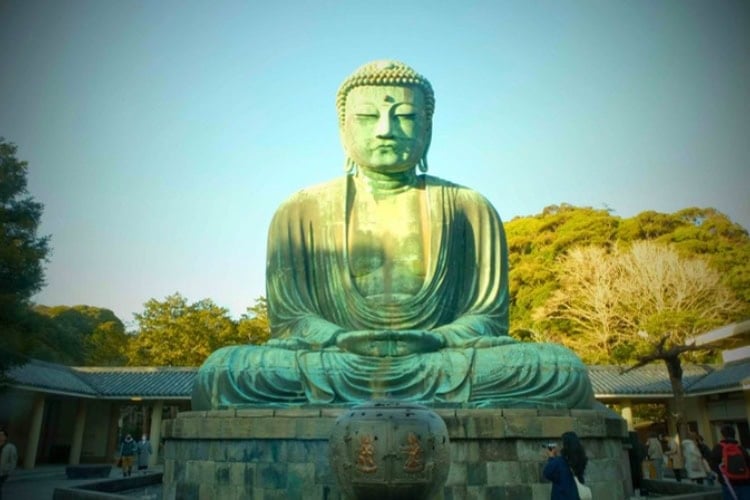
Kamakura may sit just an hour from Tokyo, but it carries the quiet weight of its past life as Japan’s political heart.
My first stop was Kōtoku-in—once called Shōjōsen-ji—home to the famed Great Buddha of Kamakura.
The bronze giant sits in the open air, serene and immovable, yet surprisingly hollow. For a handful of yen, you can step inside and feel the cool metal curve around you; I couldn’t resist.
Afterwards, standing in the presence of this awe-inspiring statue, I followed the traditional etiquette: palms together, bow, gaze at the face of the Buddha, then release.
My reward, aside from a sense of humility, was another page filled in my goshuincho.
From there, I made my way to Tsurugaoka Hachimangū, Kamakura’s grand Shinto shrine, where crimson gates rise against forested hills.
By sunset, my goshuin book held two new stamps.
Kyoto’s Gilded Calm
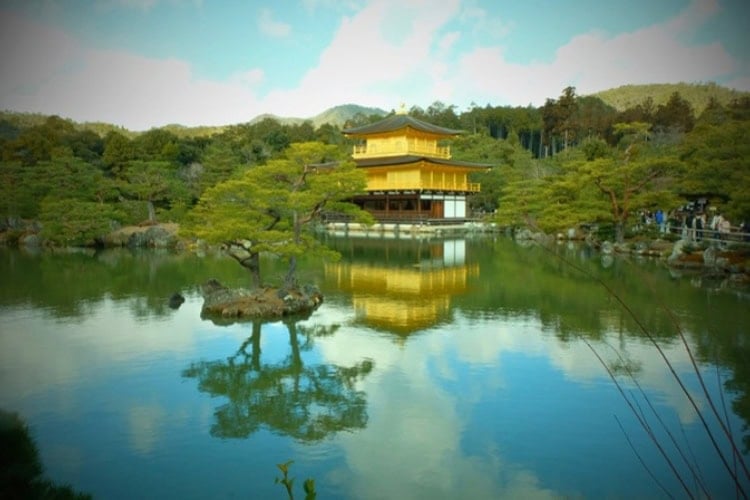
Kyoto, once the jewel of Japan’s imperial crown, held the title of capital for more than a millennium before power shifted to Tokyo in the wake of the Meiji Restoration.
Today, its legacy endures in the sheer concentration of temples and shrines scattered across its districts—each a small universe of stillness amid the city’s steady hum.
I began at Tenryū-ji, slipping in after a stroll through the whispering Arashiyama Bamboo Forest.
From there, I travelled north to Rokuon-ji—better known as Kinkaku-ji, the Golden Pavilion. It quickly became my favourite Kyoto temple.
The upper floors, sheathed in gold leaf, shimmer above a mirror-like pond, creating a scene so composed and radiant that even the crowds seemed to fall quiet around it.
My path then led to Ginkaku-ji, the Silver Pavilion that was never actually silver.
Officially called Jishō-ji, the Temple of Shining Mercy, it sits at the edge of the Philosopher’s Walk, a canal-side path framed by cherry trees.
Out of season, the blossoms were absent—and so were the crowds.
I walked in near solitude, and at each goshuin counter found only the briefest of queues.
Temple by temple, stamp by stamp, Kyoto revealed itself in moments of rare and welcome calm.
Nara’s Sacred Encounters

Nara, another former imperial capital and a place where sacred history meets free-roaming deer, was my next goshuin destination.
My first encounter with one of the city’s famed sika deer came with a price: my paper map, now mangled into a doughnut-shaped relic of my own carelessness.
Fortunately, my goshuincho was safely tucked away as I entered Kōfuku-ji, the first of three of Nara’s Seven Great Temples I planned to visit.
At the goshuinjo—the temple’s stamp counter—a silent monk accepted my book, and with swift, practiced strokes, inscribed its next page in elegant calligraphy, sealing it with two bold red stamps.
The symbols marked the temple name, date, and a brief spiritual message: pray respectfully.
From there, I moved on to Tōdai-ji, home to the world’s largest bronze Buddha, known locally as the Daibutsu.
Finally, I visited Gangō-ji, one of Japan’s oldest temples, where age itself seemed to hang in the wooden beams like incense smoke.
Snowbound Koyasan Reflections

But it was in Koyasan, a mountaintop town swaddled in snow, that my spiritual curiosity deepened.
Getting there required a train change in Osaka, another in Hashimoto, and finally a cable car ride from Gokurakubashi—a journey both literal and metaphorical.
I checked in at Fudō-in, a working temple offering lodging to pilgrims and curious travelers alike.
After receiving my goshuin and warming up with green tea, I walked to Kongobu-ji, the head temple of the Shingon school of Buddhism.
Then came Okunoin, Japan’s largest cemetery and the resting place of Kūkai himself.
Lanterns lined the path, flickering in the twilight as I approached the monk’s mausoleum in respectful silence.
Read More: Winter on the Nakasendo Trail: Exploring Traditional Japan on Foot
Ink, Memory, And Mindfulness
The following morning, I rose early to join the monks in meditation, sitting cross-legged in the temple hall, the cold seeping through the tatami mats.
In that quiet hour, I began to reflect on the deeper meaning behind what had started as a casual Instagram-inspired curiosity.
Over three weeks, I had collected two dozen goshuin, taken thousands of photos, and spent more yen than I care to count.
But what I had really gained was an invitation—however modest—into a facet of Japanese culture that is rooted in mindfulness, artistry, and spiritual connection.
I hadn’t walked a formal pilgrimage route, but my temple and shrine-hopping had become its own kind of journey.
One that encouraged me to pause, observe, and engage with a centuries-old tradition in an increasingly fast-paced world.
In each inked page of my goshuincho, I carried not just souvenirs, but stories—of monks and mountains, deer and deities, history and happenstance.
I don’t know when I’ll return to Japan, but I do know that my goshuincho will accompany me when I do.
There are many more temples to visit, more calligraphy to collect.
Perhaps next time, I’ll finally meet Tama-san.
But even if I don’t, I’ll be content knowing that what I’ve found is already more meaningful than what I thought I was looking for.
Need a hand planning your trip? Here are the sites and services we rely on most, from booking tools to travel products we love.
Inspire your next adventure with our articles below:
Author Bio: Alex is a Greek-born, London-based psychiatrist and travel writer. His work has been featured in Go World Travel Magazine and The Guardian and he regularly publishes on his blog, TravelingPsychiatrist.com.
Want to discover more hidden gems and helpful travel tips? Join our free newsletter for the latest travel secrets and travel articles.
We are reader-supported and may earn a commission on purchases made through links in this article.