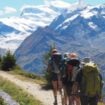
I strolled through alpine pastures dotted with grazing cows. The bells around their necks chimed in a cacophonous symphony.
As I climbed switchback paths up to mountain passes, 360-degree vistas of snow-capped peaks and glaciers rewarded my efforts. Upon hearing our footsteps, marmots popped out of their burrows, sounding warning chirps to their colony.
The Walker’s Haute Route, a two-week walk from Mont Blanc in Chamonix, France, to the Matterhorn in Zermatt, Switzerland, is a hiker’s dream.
… Or nightmare, depending on your perspective.
The Challenge

Photo by Mark Duffy
The walk logs about 120 miles and some 11 mountain passes, but who’s counting? Several days require ascents greater than 5,000 feet. Some days peak at elevations over 9,000 feet – high enough to trigger altitude sickness.
This “vacation” was my husband’s idea. We invited friends and family. Only a college buddy of my better half signed up.
Our daughters were intrigued but had limited vacation time. My husband researched trail options and booked lodgings at inns and mountain huts a year in advance.
Was I intimidated at the prospect? You betcha! I exercise regularly, but hiking every day, all day, for two weeks was far beyond my routine.
Did I mention my fear of heights and exposure? And my 66-year-old, oft-complaining, arthritic knees?
Travel insurance is essential for any trip, offering peace of mind and protection. Explore options with SafetyWing or SquareMouth to find the coverage you need.
I’ll Try…

I outlined a training regimen and agreed to see how that went. With new hiking boots and dusted off trekking poles, my husband and I set off.
Over three months, we built up to our full pack weight, ascents of 4000 ft, and distances of 12 miles. We finished with a couple of multi-day outings.
A physical therapist friend gave me exercises to strengthen the muscles around my knees. I held downhill pain in check through training with Advil, but I also scheduled a cortisone shot in both knees.
Cortisone, I learned, is only effective in the same joint a few times in one’s life. This trip was hopefully a once-in-a-lifetime event.
My Own Worst Enemy

The summer days whizzed by. I tossed and turned in the middle of the night, envisioning all the things that could go wrong.
I feared my pace was such that we would arrive at the huts after the dinner dishes were washed. How quickly could helicopter rescues arrive? How much toothpaste did I need to carry?
My knees did not balloon up during training, so I started packing.
I scrutinized the pile spread out on my bed. What could I eliminate? Rain and cold-weather gear were a must.
I selected a layered outfit for hiking that I would handwash. A set of evening clothes. Safety gear (water filter, compass, and matches) was bundled in a ziplock bag. A lightweight towel, sleep sack, and toiletries. My pack weighed 22 pounds. I’d be adding water, snacks, and lunch when we hit the trail.
I’d done all I could to prepare. Still, as we finalized our packing, my stomach was in knots. My husband, on the other hand, reminded me of a kid giddy with excitement.
Anticipation Versus Reality

I knew the scenery would be stunning and that it would be hard physical work. I knew that my daughters joining us for seven days in the middle of the trip would be delightful. That was all true. However, a few things surprised me.
The cortisone shot was magical. Only the longest descents brought any discomfort to my knees.
During the training phase, a mountain guide told us we were ready. “You’ll get stronger during the hike.” I didn’t believe her at the time, but she was right.
Having my daughters join us on our week-long trek was a godsend.
Here’s How it Unfolded…

For the first few days, the remainder of our 15-day itinerary loomed like a cursed eternity. In the wee hours, I relived the previous day’s scary heights and dreaded the next strenuous climbs.
But then something imperceptible changed. Immersed in the routine, the days whizzed by.
Breakfast was coffee and Bircher muesli, after which we donned our packs and took the daily hitting-the-trail selfie.
We stopped for snacks as the scenery, including milky, glacier-fed lakes, unfolded around us.

Upon reaching our destination, we showered, tucked into a three-course dinner served family-style, and climbed into bed.
Sometimes my husband and I shared a cozy room at an inn, pulling the duvet up to our chins. Other nights at rustic huts, we climbed into our sleep sacks, side-by-side with other hikers.
This new routine was a refreshing break from “real” life.
I relished the feeling of accomplishment, and as I scaled (with baby steps) each mountain pass, I drank in the views on the other side.
I wasn’t speedy, but we arrived in time for dinner. Satisfyingly weary as each day ended, I finally began to sleep well without being plagued by my middle-of-the-night worries.
Coping With My Nemesis

The hardest part for me was the exposure. For stretches, I required a substantial rock or a bush between me and the precipice before I was comfortable lifting my eyes and gleaning a glimpse of the scenery.
My daughters nimbly guided me through the switchbacks along exposed cliff edges. “Eyes right.” I focused on my daughter’s boots in front of me as the rocky slope dropped off steeply on my left. We rounded a bend. “Eyes left.”
Even after they departed, I stared at the boots I imagined in front of me. As I survived each of these harrowing stretches, it was I who was giddy…with relief.
At the huts, we relaxed with hot tea (sometimes served in bowls) and played games. With just four days remaining on our journey, we exchanged tight embraces as the girls boarded a bus to head home.
On Day 13, I Struggled

Maybe it was exhaustion from the back-to-back days spent hiking. I had already slogged more than 100 miles, and I dreaded buckling that hefty weight on my back.
I tried to hide it, but the tears flowed as I dealt with the exposure on the trail. Without my daughters shepherding me, I felt alone.
Then we encountered an interminable boulder field that required careful footing for what seemed like hours. I yearned to be back home with my familiar, comfortable routine.
Finally, we crossed into the valley where the end goal – the town of Zermatt – lay.
The plan called for one more day hiking up to a hut on the far side of the valley, and then a second and final day descending into Zermatt.
Those trails included a 500-meter suspension bridge and two kilometers of fixed chains. (“Fixed chains” are metal chains bolted to the rock that even people who are not afraid of heights are expected to hold onto for safety’s sake.)
An avalanche had closed a section of the trail. This now required an extra descent to the valley and an extra climb back up to rejoin the trail beyond the closure. Not to mention, the weather forecast was threatening rain.
I was not keen on the prospect of days 14 and 15.
As I wallowed in my feelings of dread, we finished the day with a gondola ride, relieving us of a steep, knee-jarring descent.
We met a couple who would be finishing the Walker’s Haute Route the next day. They had walked the entire distance seven years prior and mentioned fond memories of completing the 13-mile valley trail from St Niklaus to Zermatt.
My ears perked up. A valley trail? With no suspension bridge and no fixed chains? I would still have walked from Chamonix to Zermatt, I reasoned. And something about completing this epic trek with a day on my own appealed to me.
My spirits buoyed as I embraced the idea of this valley hike.
A Finale on My Own Terms

My husband and his college friend opted to carry on with the original plan. “You can still join us,” my husband suggested. “You can do it.”
“Yes, but I don’t want to do it,” I tried to explain. The valley trail was well-traveled, so we both felt safe enough with my plan.
My daughters cheered me on from afar. “Good on you for doing what you want. Give our regards to the Matterhorn.”
Day number 14 (you can bet I was counting) brought misting rain that cleared by midday. I read a sign in German requesting photos and location info of any wolves spotted. Ordinarily, I would love to see wildlife, but please not today by myself.
I passed through several villages with tidy houses and overflowing window boxes of geraniums as the miles clicked by.
I crested one more hill and the town of Zermatt came into view. Hooray!
Sweet Success

After two weeks on tranquil mountain trails, I was jarred as I strolled into the tourist-infested Zermatt. Guides led dozens of sightseers past gleaming high-fashion stores.
I dodged taxis zipping by and stepped out of the way of families wheeling ginormous luggage.
An ice cream shop caught my eye. I celebrated with a scoop of gelato. I soaked in the welcome relief that the hike was done and sighed contentedly.
Despite my doubts and self-imposed stress, I’m glad I tackled the Walker’s Haute Route. Did I learn something about myself? Will I be more confident and worry less in the future? Probably not. It’s not how I’m wired. But for now, I’m proud of my accomplishment.
On the plane home, my husband asked, “Where’s our next vacation?” I wasn’t ready to contemplate that question. But whatever it is, I’m in.
If You Go

The book Chamonix to Zermatt: The Classic Walker’s Haute Route by Kev Reynolds is a great resource. We also enjoyed the photos and advice provided by Earth Trekkers Walker’s Haute Route. Seek out your own challenge!
Gear Guide
Need a hand planning your trip? Here are the sites and services we rely on most, from booking tools to travel products we love.
Inspire your next adventure with our articles below:
Author Bio: Jean Duffy is a nonfiction writer published in the Boston Globe, the Concord Monitor, PBS Next Avenue, NPR Cognoscenti, and other venues. She is the author of the award-winning book, Soccer Grannies: The South African Women Who Inspire the World. More at https://jeanduffy.com/.
Want to discover more hidden gems and helpful travel tips? Join our free newsletter for the latest travel secrets and travel articles.
We are reader-supported and may earn a commission on purchases made through links in this article.