Etihad Airways will begin flying its double-decker Airbus A380 widebody quadjets from its main hub at Abu Dhabi International Airport (AUH) to Japan’s  Tokyo Narita Airport (NRT) next summer. From mid-June, the ‘superjumbo’ will serve this route on a daily basis during some of the year’s busiest months.
A key development that will enable this capacity upgrade on the route from Abu Dhabi to Tokyo Narita will be the UAE flag carrier’s reactivation of an eighth Airbus A380, as it continues to increase the type’s usage throughout next year. While, unlike some of the A380s operated by rival UAE airline Emirates, these jets do not have a premium economy cabin, they do feature the legendary three-room ‘Residence’ first class suite on the top deck.
Etihad Brings The A380 To Tokyo As It Reactivates Eighth Aircraft

 Etihad Airways confirmed in a statement released earlier today that, as of June 16, 2026, it will be deploying the Airbus A380 daily on its route from Abu Dhabi International Airport to Tokyo Narita. According to present scheduling data made available by Cirium, an aviation analytics company, this corridor is currently served daily by Etihad’s 371-seat Airbus A350-1000s, with the switch to the A380 seeing 115 seats added on every flight.
The news comes as Etihad gears up to bring two more Airbus A380s back into service in 2026. This is a hot topic at the Abu Dhabi-based UAE flag carrier at present, and came up in conversation at the 2025 Dubai Airshow. Indeed, when speaking to Simple Flying’s Managing Editor, Tom Boon, at the event (as seen above), Majed Al Marzouqi, who currently serves as the Chief Operations and Guest Officer at Etihad Airways, explained that:
« As you know, we have 10 A380s. Out of the ten, today, seven of them are operational. Next year, we are activating aircraft eight and nine. We’re going to have only nine aircraft. The tenth one we are using for parts. »
Responding To Increased Demand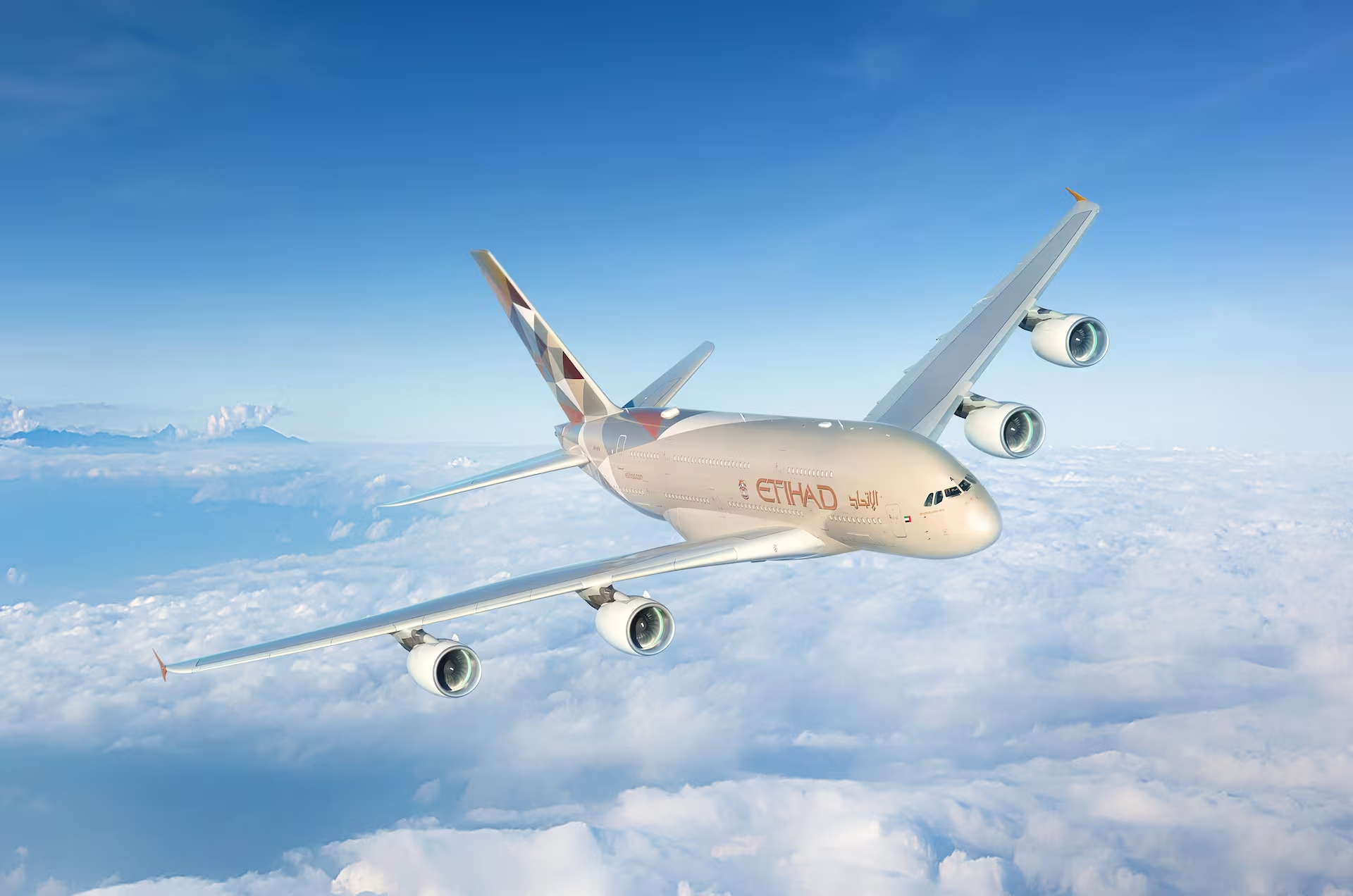
Etihad also confirmed the numbers and timings of the daily flights that the Airbus A380 will be operating on the route from Abu Dhabi International Airport to Tokyo Narita as of mid-June. Flying east, the outbound leg will be numbered as EY800, leaving Abu Dhabi at 21:25 and reaching Tokyo at 12:45 the next day. After just over five hours on the ground, EY801 will leave Tokyo at 18:00 and reach Abu Dhabi at 00:20 the following day.
Arik De, who serves as the Chief Revenue and Commercial Officer at Etihad Airways, explained that « strong demand from customers for more seats to Japan » was a key factor in making next summer’s aircraft switch a reality. De also cited « the importance of business travel between the UAE and Japan » as a driving force, given that they are « two nations with deep economic and cultural ties » and the A380 has an abundance of premium seats.
At present, Etihad’s daily flights are the only non-stop services connecting Abu Dhabi with either of Tokyo’s main airports. However, its UAE rival and neighbor Emirates serves both from Dubai International Airport (DXB) on a daily basis, flying the A380 to Narita and the Boeing 777-300ER to Tokyo Haneda (HND).

Crazy! How 2 Economy Passengers Ended Up In Etihad’s A380 Residence
Etihad’s Residence suite is one of the most luxurious airline experiences around.
What’s It Like Onboard?

As mentioned, Etihad’s Airbus A380 jets will offer a 115-seat (31%) capacity boost compared to the 371-seat A350-100 twinjets that currently ply the route between Abu Dhabi and Tokyo Narita, with space for a grand total of 486 passengers onboard. 11 of these are found in first class at the front of the upper deck, of which two can be accommodated in the ‘Residence,’ an opulent three-room suite with its own bedroom and bathroom.
According to aeroLOPA, the remainder of the upper deck is occupied by 70 business class flatbeds laid out four-abreast in a 1-2-1 configuration. Downstairs, economy class occupies the entirety of the lower deck, with 405 seats. These are mostly 10-abreast, but there are some exceptions near the exits.